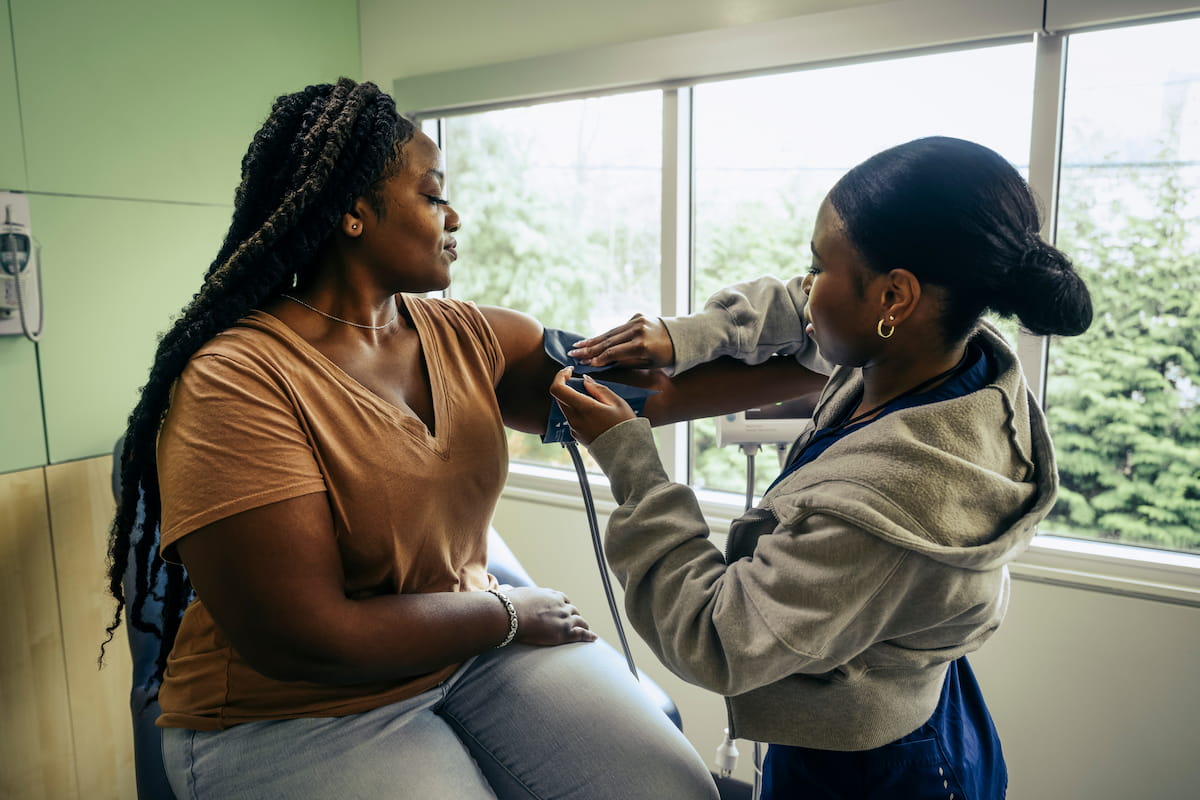
Hypertension, also known as high blood pressure, is a medical condition where the pressure of blood against the walls of your arteries is consistently too high. Over time, this increased pressure can cause health problems, such as heart disease, stroke, or kidney damage.
Hypertension impacts millions of adult Americans and is a significant cardiovascular risk factor, accounting for roughly 50% of stroke and heart disease cases globally.1,2 In 2021 alone, high blood pressure played a role in over 691,000 deaths in the United States (US).3 The impact is especially strong among African Americans, with more than half of African American men (55.8%) and women (56.9%) living with high blood pressure, according to the 2017–2020 National Health and Nutrition Examination Survey.4,5These numbers highlight the urgent need for awareness and action to tackle this silent but dangerous condition.
Blood pressure is measured in millimeters of mercury (mmHg) and expressed as two numbers:
Systolic blood pressure(SBP) (top or higher number): The pressure in your arteries when your heart beats.
Diastolic blood pressure(DBP) (bottom or lower number): The pressure in your arteries when your heart is resting between beats.
Category
Systolic (mmHg)
Diastolic (mmHg)
Normal
<120
<80
Elevated
120–129
<80
Hypertension Stage 1
130–139
80–89
Hypertension Stage 2
≥140
≥90
Hypertensive Crisis
>180
>120
Causes of Hypertension
Primary (essential) hypertension: The most common type, affecting 90% of people with hypertension; no identifiable cause; develops gradually over time.
Secondary hypertension: Much less common; caused by an underlying condition, such as kidney disease, thyroid problems, or medication side effects.
Risk Factors
Age
Family history
Obesity
Physical inactivity
High salt intake
Excessive alcohol consumption
Smoking
Stress
Certain chronic conditions, like diabetes.
Symptoms
Hypertension is often called a “silent killer” because it typically has no symptoms until it becomes severe. In extreme cases, symptoms may include:
Severe headaches
Nosebleeds
Shortness of breath
Dizziness or vision problems
Management and Prevention
Lifestyle changes:
Eating a healthy diet (e.g., DASH diet)
Reducing salt intake
Regular exercise
Weight loss if one is overweight
Maintaining a healthy weight
Limiting alcohol consumption
Quitting smoking
Medications: Medications can be prescribed in cases where lifestyle changes are insufficient. Using two or more blood pressure medications is often more effective than using just one.
Managing blood pressure effectively is key to reducing the risk of complications. Regular monitoring and routine check-ups with a healthcare provider are important.
Despite the numerous approved medications, an estimated 92.9 million people (77.5%) with high blood pressure still have uncontrolled levels.
What is resistant hypertension?
Resistant hypertension is a type of high blood pressure that remains elevated despite treatment with at least three different types of antihypertensive (blood pressure lowering) medications at their optimal doses. These typically include:
A calcium channel blocker: These medications work by relaxing the muscles in your blood vessels, and some also help slow down your heart rate.
An angiotensin-converting enzyme (ACE) inhibitor or angiotensin II receptor blocker (ARB): These medications help relax blood vessels.
A diuretic (water pill): These medications help remove sodium and water from the body.
While the precise prevalence of resistant hypertension is unknown, studies suggest that it may represent up to one third of participants with hypertension with an even higher preponderance among African Americans.6,7 In the US, the National Health and Nutrition Examination Survey estimates that resistant hypertension accounts for 11.8% of all hypertension cases, impacting approximately 9 million Americans.22 Globally, resistant hypertension affects 12–20% of individuals with high blood pressure, equating to approximately 300 million people worldwide.
Despite its widespread prevalence, resistant hypertension remains a significant unmet need, as no drugs or devices have been specifically approved by the US Food and Drug Administration (FDA) to treat this condition. 8,9
Characteristics of Resistant Hypertension
Blood pressure remains above 140/90 mmHg despite treatment with three medications.
Often requires combination therapy with multiple classes of blood pressure-lowering medications.
Causes of Resistant Hypertension
Lifestyle Factors:
High salt intake: High salt intake is strongly linked to elevated blood pressure, and individuals with salt sensitivity are particularly at risk. Low potassium intake from insufficient consumption of fruits and vegetables can also contribute.
Obesity: Excess body weight increases the workload on the heart, leading to higher blood pressure. Obesity is one of the most common contributors to resistant hypertension.
Physical inactivity: A sedentary lifestyle weakens cardiovascular health, making blood pressure more difficult to control.
Excessive alcohol consumption: Drinking large amounts of alcohol can raise blood pressure and reduce the effectiveness of antihypertensive medications.
Secondary Hypertension:
Underlying conditions such as:
Chronic kidney disease (CKD)
Obstructive sleep apnea (OSA)
Primary aldosteronism
Thyroid dysfunction
Pheochromocytoma (a rare adrenal gland tumor)
Renal artery stenosis (narrowing of kidney arteries)
Medication-Related Issues:
Use of substances that raise blood pressure, such as:
Nonsteroidal anti-inflammatory drugs (NSAIDs)
Decongestants
Certain antidepressants
Excessive alcohol
Recreational drugs (e.g., cocaine, amphetamines)
What are the risk factors for resistant hypertension?
You’re more likely to have resistant hypertension if you:
Have chronic kidney disease: Kidney dysfunction can make it harder to manage blood pressure because of fluid retention and changes in hormone production.
Have diabetes: Diabetes often coexists with high blood pressure and can increase the difficulty of managing both conditions together.
Are African American: African Americans are disproportionately affected by resistant hypertension, likely due to a combination of genetic, environmental, and socioeconomic factors.
Were assigned male at birth: Men are generally at a higher risk of developing resistant hypertension at a younger age than women.
Thorough medical history review and physical examination.
Laboratory tests to identify secondary causes.
Ambulatory blood pressure monitoring to rule out “white coat hypertension” (elevated readings only in clinical settings).
Treatment
Optimizing Medications:
Adjusting the dosage or type of antihypertensive drugs.
Including a diuretic if not already used (e.g., chlorthalidone or spironolactone).
Treating Underlying Conditions:
Managing secondary causes like sleep apnea or hormonal imbalances.
Lifestyle Modifications:
Low-sodium diet (e.g., DASH diet).
Weight loss and exercise.
Limiting alcohol intake.
Advanced Interventions (in select cases):
Renal denervation (a procedure to reduce nerve signals to the kidneys).
Baroreceptor activation therapy (a treatment that involves stimulating the baroreceptors—special sensors in the blood vessels that help regulate blood pressure).
Importance of Specialist Care
If resistant hypertension is suspected, consultation with a hypertension specialist or cardiologist is often necessary for advanced evaluation and management.
Impact of Hypertension in African American population
Hypertension has a disproportionately high impact on the African American community, making it a significant public health concern. Here are key points highlighting its effects:
Higher Prevalence
African Americans have some of the highest rates of hypertension globally. According to the 2017–2020 National Health and Nutrition Examination Survey:
55.8% of African American men have hypertension.
56.9% of African American women have hypertension.
These rates are higher than in other racial and ethnic groups in the United States.
Early Onset
Hypertension tends to develop earlier in African Americans, often starting in young adulthood. This early onset increases the risk of long-term complications.
Severe Health Outcomes
African Americans with hypertension are at a higher risk of developing:
Stroke: African Americans are nearly twice as likely to have a stroke as non-Hispanic whites.
Heart Disease: Hypertension contributes significantly to heart attacks and heart failure.
Kidney Disease: African Americans are nearly four times more likely to experience kidney failure compared to whites, partly due to uncontrolled high blood pressure.
Genetic and Environmental Factors
Genetic predispositions, such as increased sensitivity to salt, contribute to higher blood pressure levels in this population.
Environmental and socioeconomic factors, including limited access to healthy food, healthcare disparities, and higher stress levels, also play a major role.
Barriers to Treatment
African Americans are more likely to experience resistant hypertension, meaning their blood pressure remains high despite taking multiple medications.
Healthcare access disparities and medication affordability can also make it harder to achieve proper blood pressure control.
Need for Targeted Solutions
Addressing hypertension in the African American population requires a combination of education, improved access to care, community outreach, and research into new treatments tailored to this group’s unique needs.
Hypertension not only affects the health of African Americans but also has profound social and economic implications, making it crucial to prioritize prevention, early detection, and effective management.
Lawes CM, Vander Hoorn S, Rodgers A. Global burden of blood-pressure-related disease, 2001. Lancet. 2008;371:1513-1518
Ong KL, Cheung BMY, Man YB, Lau CP, Lam KSL. Prevalence, awareness, treatment, and control of hypertension among united states adults 1999-2004. Hypertension. 2007;49:69-75
Martin SS, Aday AW, Almarzooq ZI, Anderson CAM, Arora P, Avery CL, et a. American Heart Association Council on Epidemiology and Prevention Statistics Committee and Stroke Statistics Subcommittee. 2024 Heart Disease and Stroke Statistics: A report of US and global data from the American Heart Association. Circulation. 2024;149(8):e347-e913.
Centers for Disease Control and Prevention and National Center for Health Statistics. National Health and Nutrition Examination Survey (NHANES) public use data files. https://cdc.gov/nchs/nhanes/ Accessed May 23, 2024.
Sarafidis PA, Bakris GL. Resistant hypertension: An overview of evaluation and treatment. Journal of the American College of Cardiology. 2008;52:1749-1757
Hanselin MR, Saseen JJ, Allen RR, Marrs JC, Nair KV.; Description of antihypertensive use in patients with resistant hypertension prescribed four or more agents. Hypertension. 2011 Dec;58(6):1008-13.
Sarafidis PA, Bakris GL.; Resistant hypertension: an overview of evaluation and treatment. J Am Coll Cardiol. 2008 Nov 25;52(22):1749-57.
BlackDoctor is the world’s largest and most comprehensive online health resource specifically for the Black community. BlackDoctor understands that the uniqueness of Black culture - our heritage and our traditions - plays a role in our health. BlackDoctor gives you access to innovative new approaches to the health information you need in everyday language so you can break through the disparities, gain control and live your life to its fullest.
✦ AI Search Disclaimer This AI-powered search tool helps you find relevant health articles from the BlackDoctor.org archive. Please keep the following in mind:
✦ For Informational Purposes Only The information provided through this AI search is for general educational and informational purposes only. It is not intended as a substitute for professional medical advice, diagnosis, or treatment.
✦ Always Consult a Healthcare Provider Never disregard professional medical advice or delay seeking it because of something you have read through this search tool. If you have a medical emergency, call your doctor or 911 immediately.
✦ AI Limitations This search tool uses artificial intelligence to help match your queries with articles in our archive. While we strive for accuracy, AI-generated results may occasionally be incomplete, outdated, or not fully relevant to your specific situation.
✦ No Doctor-Patient Relationship Using this search tool does not create a doctor-patient relationship between you and BlackDoctor.org or any healthcare provider.
Explore over 35,000 articles and videos across black health, wellness, lifestyle and culture