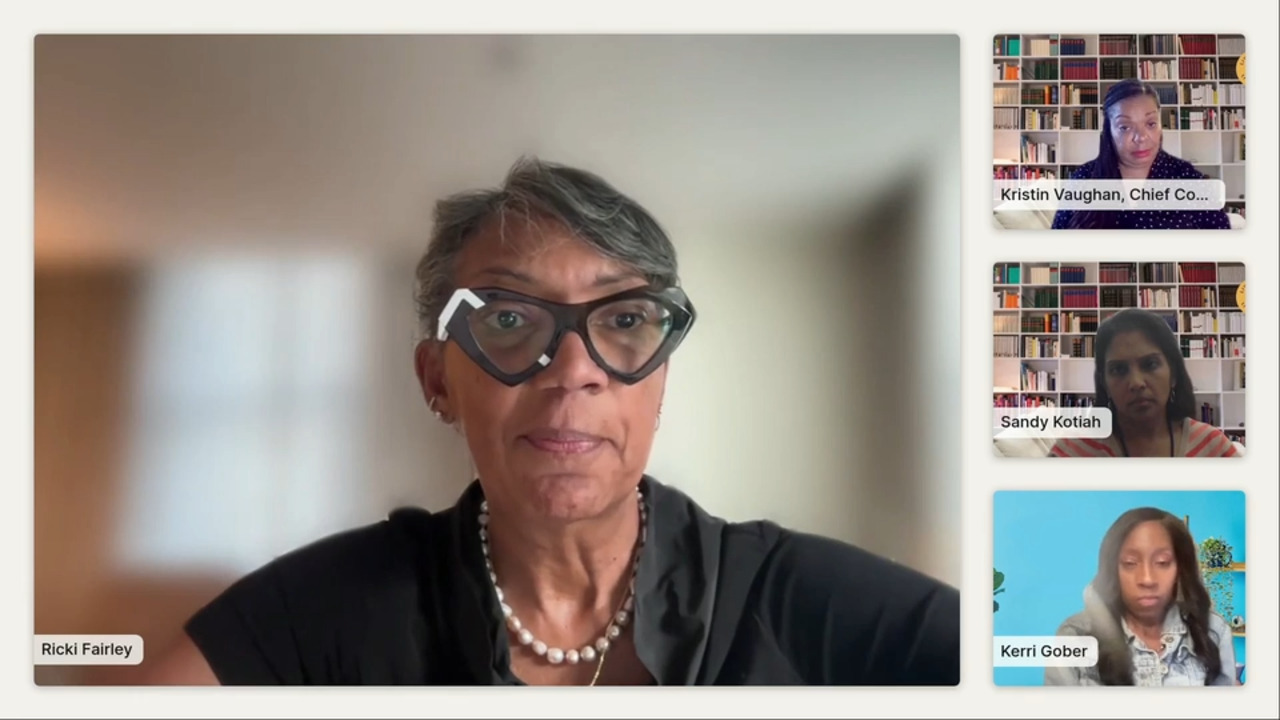
All right, welcome, welcome. So again, today's panel is about cardiovascular health. So again, I wanna thank my panelists. One more round of applause for them. All right, and I'm gonna start and let everybody share a little bit about their background, who they are, and what they're bringing to the conversation, which is gonna be a lively one. Dr. Jayne Morgan, if you could start off for us. Sure. My name is Dr. Jayne Morgan. I'm a cardiologist and a women's health and menopause expert, and have really gravitated into that area in the last few years. My background really is in research.
I was at Piedmont Healthcare, the largest healthcare system in Georgia, for nine years leading their cardiovascular research program, but now am the vice president of medical affairs for Hello Heart, which is a, which is a digital AI company moving forward in the women's health space. We actually have just been named the fastest growing company in Silicon Valley. So that's where we are today. Yes. Amazing. Thank you. Dr. Tony Lazama, tell us a little bit about your, your background. Thank you, and thank you, BDO, for allowing me to be here on stage with these luminaries.
Congratulations, that's awesome news about the company. So, my name is Tony Lazama. I am one of the US medical directors in cardiovascular disease at Novartis Pharmaceuticals, and so I am really focused on obviously cardiovascular disease, but really driving awareness around the issue of cardiovascular disease, and particularly with the African American community, but just as a whole.
I'm really, really focused on elevated LP little A, that's my daily bread and butter, but I'm also involved with cholesterol and blood pressure as well. And at the company, I lead a lot of our initiatives when it comes to testing and being out within this community and raising awareness, but also a lot of our implementation science work and a lot of our partnerships with sports, including the NBA and the NFL. And additionally, really driving the ball forward, no pun intended, with the sports on a lot of the AI work that we've been doing. And so I actually am fortunate enough to lead a couple of different AI initiatives where we're trying to leverage that technology to help providers and patients alike.
We're gonna come back and talk a little bit more about that 'cause AI, AI is on the lips of everybody, so we always wanna know what's going on there. Dr. Keith Ferdinand, if you could tell us. Yeah. I'm Dr. Keith Ferdinand. I'm a professor of medicine at Tulane University in New Orleans, Louisiana, my hometown. I'm from New Orleans, and the endowed chair in preventative cardiology at Tulane. I'm also chief science officer of the Association of Black Cardiologists. I've practiced medicine for many decades, both as a clinician, I also do research and a lot of community intervention.
We have a large NIH grant. We go into the churches in New Orleans and control blood pressure, lipids, and glucose in a community setting. My whole, career has been dedicated, especially to the Black community.
I'm a child of the Lower Ninth Ward, and if you look at the number one cause of death of the white Black mortality gap, cancer of course is very important, but it's overwhelmingly cardiovascular disease, so that's where I put my focus. That's a lot. You've got a lot on your shoulders. All of you are actually taking on such important work in the community, and we're proud to have you guys on the stage today because the accomplishments that you guys have brought already are so meaningful. There's a lot of work to do. Let's get into it. So one thing I wanna talk about is the seri-- if we're serious about changing the outcomes in the Black community, and obviously we are, in the next five to 10 years, what would you say is the one shift that needs to happen when we're looking at clinical, community-based, whether it's policy-driven, what would have the greatest impact on reducing heart disease in Black communities?
I think the number one cause of poor outcomes is not having insurance. They have actually done studies, and they look at uninsured versus insured. People who don't have insurance can't get care. They get care late. They use the emergency department as their primary source. So when you go to the doctor, when you can't urinate, so you already have end-stage renal disease, you're on dialysis. When you can't breathe, you have heart failure, your heart's already giving out. When you have chest pain, I call it the Fred Sanford syndrome, you've already had a heart attack. And many of those things are preventable if the person will get early care.
Now we know even persons who have insurance, the insurance is often limited in its scope. I used to work in a restaurant called Rawls & Nusser. It's still there. It's a hotel on Bourbon Street, and it was minimum wage and all you could steal. You didn't have insurance. You had a gig, but when Essence would leave and the Super Bowl would leave and Jazz Fest would leave, "Bill, we don't need you next week." Mm-hmm. So those are really big drivers, the social drivers of health, not only the built environment where you live, but not having access to care. Access to care, having the access to the insurance.
Got it. And, and I'll just add to the conversation. I think when we're talking about digital health, it is my projection as we look forward that this may be an opportunity to really close the gap in healthcare, to put healthcare in the hands of people who already are utilizing their phones, who are already utilizing, wearables to begin to connect the dots such that people understand how their behaviors during the dayActually are contributing to risk factors that may end up with an emergency room visit six months later. So how can we intervene today? What, what, what alerts can we give you?
How can you track your blood pressure? How can you track your cholesterol? How can we track your heart rate, but then give you those insights where you can start to connect the dots and say, "Aha, I see here X led to Y, and if I don't intervene now, I'll end up Z in the emergency room." And so, you know, I think as we move forward, we will see increasingly the general public being empowered with digital access to make good inform-- to make good decisions.
And my hope is that in communities like our community, the Black community, that this will, will allow us to begin to close the gap in access to healthcare, give you information such that you can make decisions as best as you can in real time and can make behavioral changes. Because we know that eighty percent of cardiovascular disease is behaviorally driven. These are our choices, and sometimes, as Dr. Ferdinand says, these are not our choices. It's where we live, where we work, the foods that we're eating. peop- some people have more choices and decision-making over that than others, but all of this contributes, to heart disease.
There's only about fifteen percent or so or twenty, that is, not related to sort of our overall, lifestyles. And so that's where I would like to see sort of it, it going, where we're putting it in the hands of people to be able to make decisions, preventative decisions to improve their lives. A-and tying in with digital health, like you said, that's great because our community is disproportionately using our phones and things. So you've gotta get the health apps on the phone and not just be looking at whatever else might be on the phone, using it for good, using it for your health while you've got it in your hand.
That's perfect. Dr. Lazama. So I agree with both comments. I, I think bridging the gap between the ivory towers and the community itself, and so digital can be a huge part of that. So if we're already on our phones, let's try to tap into this to not just bring an app, but usable information through partnerships, whether it be with ABC or BDO or whomever- Mm-hmm ...that you can have digestible materials that are at the cultural relevancy level that will pick up and resonate with folks.
And then at the same time, it's a pincer movement. Those community centers that are not the big academic medical centers- Yes ...making sure people there know what they need to know and that they're empowered. And so we have ample evidence showing that if you can actually educate and find champions within those community health centers, those federally qualified health centers, you can actually make a big shift in terms of outcomes, whether it be screening, testing, just overall health benefit. And so I think bringing it all together to where we address the social determinants of health issues by empowering the community centers where these people potentially could go and they're closer, as opposed to a big academic medical center where they may be a little bit intimidated to go to.
But then also leveraging those digital tools so that when they do show up, whether it be at, you know, Georgetown Health or, you know, Delaware Valley GAP Health Center- ...they will have the knowledge that they have and that they need to have in order to better represent themselves and advocate for themselves when it comes to their health. And it, and it cr- it drives more meaningful conversations with the physician- Yes ...because you come with your data that the physician can now review and see what's really happening to you out in the real world. And I think sometimes what we don't have are meaningful conversations with the doctor who comes in, they have a short period of time.
Yep. You're flustered, you're intimidated, and you don't-- You sometimes, especially for women, we leave with more questions than we came in with.
Yeah. And, and nobody really addresses it. You bring me t-to my next question, which is hearing about that heart attacks present differently in women. And as you're saying, we leave our doctor's office with more questions as women. When we're out there dealing with heart attacks at a level where we often have the idea that heart attacks and women don't come together, when we think about heart attacks with women, and now we know as a result that things are na- negatively impacting women, what are the warning signs for women? How can we change that narrative? Because again, I think the idea is heart attacks, we don't think about women.
So when women are quick and on the move, what are we missing that we're thinking this is just part of what we normally do and are running around? What are the warning signs that women are missing? Yeah. The, the biggest warning sign is just being a woman. And I will tell you why that's the biggest warning sign. It's the biggest warning sign- I agree. I agree ...because it's a blind spot in the health system. It is. We are not seen. Yeah. And so the biggest risk factor is just having two X chromosomes in the United States of America because there's a blind spot in the health system.
Now, if I wanna talk about specific medical, transitions in a woman's life, you know, there are specific times when our risk of heart disease increases, where we are also ignored. And so one of those would be pregnancy, pregnancy complications. You hear about hypertension, gestational hyper, diabetes, and, low, even low birth weight babies, pre-eclampsia, those kinds of things.
Those are all risk factors for heart disease. That woman has a twofold increased risk of heart disease in her lifespan. And we really don't have the integration of cardiologists in the care of that patient. So let me give you an example why diversity is important. It's not just when we talk about diversity, we talk about in medicine coming out of our silos, all of the doctors talking. You know, when I trained in cardiology right here at George Washington University, this is where I did my internal medicine residency, by the way. I'm back home. I lived down at 2000 F Street, if you guys wanna see where I lived.
Now it's totally unaffordable, but back then, these were the cheap seats, right?And this is where I lived, right down the street from the, from the hospital, in a studio apartment. I had a beautiful view of the brick wall of the next building 'cause that's what I could afford. now even that apartment is unaffordable. but when we, when we talk about what, what happens, in healthcare to women An OBGYN sees a patient, really manages these patients with pregnancy complications. And an OBGYN is trained and will say, "This is a thirty-eight-year-old woman in her thirty-second week of pregnancy with pre-eclampsia." A cardiologist comes in to see that same patient and says, "This is a thirty-eight-year-old woman in a volume overloaded state who has just failed her stress test." Same patient.
We're going to be driven in different outcomes, but that cardiologist is not, is not a part of that conversation.
And right here where I trained, at George Washington University, I don't even know where the OBGYNs were in the hospital. They were-- We called them They had their own ER entrance. They were like over, we called it the happy side of the hospital. They, they're over in the happy side. The rest of us were, you know, in grunge work, and they were delivering babies and, you know. So when I say there's no interaction, I literally to this day still don't know where the maternity ER entrance is to the hospital where I literally trained. That's how siloed it was. We never went over there.
And so the records and- That's right. -now pulling together the same patient- Not only the records, we didn't have the conversations. You know, if we were friends, we see each other in the cafeteria. So that's the kind of thing where these silos have to break down. The next stage is in menopause, where your risk of heart disease also increases, and that's also, completely ignored. And so that, this is why I say being a woman is the risk factor. Gotcha. Dr. Ferdinand, could you build on that as well? Which part? Um- Does it, does it start with being a woman? Well, actually, if you look at heart disease- Yes age is a powerful predictive risk.
When we get older, our risk accelerates. When a woman goes through menopause five to six years late, average menopause is fifty-one point three years. So after that time, there's an acceleration in blood pressure, lipids and risk. There are more older women than older men, so there are actually more people with heart disease who are women than men in the United States.
And in terms of the identification of a heart attack, yes, it may manifest itself in very strange ways. You may not get the crushing chest pain into the left arm that a man may have. Some women will just feel fatigue or indigestion or tired. And if the clinician is not taking that woman's symptoms seriously, then he will tell her, "You know, you're nervous," or, "You're working too much," or, "You need to get more rest," without really investigating what's going on. And that is a real problem. It is a blind spot. I agree with that. So as a Black woman going to the doctor, how do I get them to take me seriously?
How when I say, what'd you say, indigestion and fatigue and all of the things that maybe go into a busy lifestyle, family- Right all of the responsibilities. Tony can talk about this somewhat. You have to know your risk factors. There are things that we measure, the conventional blood pressure, the glucose, the cholesterol. The new one is lipoprotein little A. It's a genetic factor, and it's an equal opportunity factor. It's more common in people of Sub-Saharan and, Sub-Saharan African and South Asian descent. But it also manifests itself as heart disease, especially in women and earlier in life.
And I have had patients who have very high LPAs, and Dr. Morgan knows about this, and nobody told them, and they went on to have an event. And hopefully, in the future, we can address that. One thing I did wanna say is that, although my colleagues talked very eloquently about AI and information tools and, and et cetera, I'm concerned with misinformation, junk.
Okay. I'm gonna say something that's provocative, but you do your own research, as they say, and you'll find out it's true. A lot of what's on the internet is not based on science. It's based on someone who has an agenda. It's often an individual who has a product to sell or wants you to join their club. And in the worst-case scenario, this is what's really provocative, it's international marauders, especially from Russia, who not only, inject themselves in our politics but inject themselves in our medicine and purposely will send misinformation. So as you get those tools out, Tony and Jane, make sure that they're valid, the information is valid, 'cause there are gonna be a lot of people gonna send information to be disseminated to the population that is actually harmful.
Got it. Dr. Tony Lozano, please hop in and You said a lot of very, very factual things, and I think with AI it's very important to note garbage in, garbage out, as my mentor used to say. So we are taking some steps to make sure that we don't have garbage going in. And so when we think about AI and these large language models, you have to make sure that it's not filled with filth. Because if you get that filth going in, you're going to get filth coming out, whether it be Russian filth or Chinese filth or, you know, filth is filth. I really don't- What are, what are the guardrails?
What are the steps that you guys are taking to keep it pure? So I think that's a great question. It's an outstanding question. On our end, with the projects that I'm working on, it's to make sure that we're keeping the data clean and there's lots of quality control checks, and so we're not allowingJust inherent bias to come in.
And so if we're trying to build a data set, for example, to find patients that are at higher risk- Yeah we're not gonna build a data set on only white men, because if it's only white men, then it won't recognize Black women, it won't recognize, South Asian men. So things like that, understanding it before you go in will be very important. We talked about female risk and, you know, like a lot of times you're brushed off, you're tired. I was raised by Black women, they're always tired. Mm-hmm. and they're always tired because they had to raise me. So with that being said, I think it's really important that information gets out there.
And so I was having this conversation actually with Jade just a little bit ago. this is not Novartis data. This is data from the American Heart Association, and they showed that Black women over the age of 20, 60% of them have some form of cardiovascular disease. So if you're in a situation to where you're actually seeing a Black woman and she's talking about symptoms that could sort of be a heart attack, but it's not straight away, just understand and recognize that, hey, you know, she probably is part of that 60% group. There's a three in five chance that she's in that 60%.
Dr. Ferdinand mentioned elevated Lp. This is an emerging risk factor that's not your fault, it's genetic. So it's not because you ate wrong or you didn't exercise. You're just born this way, and if you're a Black person, you're more likely to have it. One in five people have it, but if you're Black, it's more like one in four.
We have data that shows that it's much more. But with that- Do you have to ask to be screened for it- That's a great question. I was- or what kind of genetic testing? I was just gonna get to that. And so, you know, we're, we're here. We're- Right. We're here. So it's a simple blood test. So much like what Rodney was saying, where it's just like it's a, it's a simple blood test. This is not a cheek swab. Nobody's going to put your DNA in a database. It's a simple blood test. You do it one time, and you'll know if you're high, then you're high. You're-- This is genetic. If you're low, then you're low.
Like it's one time, and it's really, really straightforward, and you have to ask for it though. Now, recently, the AHA and the ACC, so the governing bodies, have come out with new guidelines recommending that all adults are checked at least once in their lifetime. So that's real great progress- Wow because it hasn't really happened before. But I do think if we're gonna be talking about women's health, African American women's health, it would be important to, consider elevated Lpas well, because all of the data shows that we have, that Black women, not only are they more likely to have it, they have the highest levels compared to anybody.
Wow. And that was shown, in some of the work that, Dr. Morgan was a part of, that Dr. Ferdinand was part of, that I was a part of, and others as well. And, and I'll just add to that because I, I'm, I'm on the steering committee of this Lpat Novartis.
So I, so I just wanted to add one little perspective from a women's health. Estrogen has been shown to cause some regression of Lpof 10% of it that's not genetic. So something to just consider as we go through perimenopause and menopause, and you think about hormone replacement therapy and the effects of estrogen on the body. It looks, we're looking at the data, it looks as if estrogen also may have some impact on a small portion of that Lp. So more to come as we sort of dig deeper into women's health and heart disease. That's amazing. Thank you guys on the panel. Thank you so much for giving us such new perspectives, putting screenings, additional screenings on our, on our plate, giving us more information to be armed for our next appointments with our physicians, asking for some of the testing.
So thank you. We're gonna take a couple quick questions from the audience. I see one over here. Oh, and I c- can cannot, not acknowledge our CEO of Black Doctor. Please stand. Good morning, everyone, and I really, really, really appreciate this panel. we asked about the main risk factors for poor access to care for cardiovascular disease, and you talked about insurance, you talked about access. And, you know, for somebody who's insured, who's a physician, who has great access, I think what we're missing is the inherent bias of the healthcare system when it comes to treating women, Black women, even educated Black women.
When you go to the emergency room, they brush off your symptoms, and if you don't fight and ask, you're not gonna get what you need.
And so I do wanna call out that we need to figure out a way to help our communities be more health literate, so they have the language to advocate for themselves when they go to the emergency room. If my mom goes alone, she doesn't get the same kind of care than if I go with her, and I can't go with her all the time. And it happens over and over and over again. So how do we pass this information to the general population so they have trusted information that is legible, thing that they can understand, visual, and then take with them to advocate for their, for their cardiovascular health?
I think that's a missing link in this conversation. Send them to blackdoctor.com. We have a, we have a lot of the resources and information that you're talking about there in terms of bringing people up to speed on the most recent screenings, awareness, detection, things that they need to know. But in addition to that, I'm gonna throw that to Dr. Ferdinand. No, I don't disagree with that at all. There's clear bias in the system, and how people are treated by the clinicians is a big part of it. The mistreatment, the unawareness of differences. Even when you take digital things like the watch that people wear, it may not pick up the color.
Your, your skin may have a different interpretation, whether you have blood pressure and your heart rate. Even the, the oximeter that was used during the COVID pandemic, the numbers would be often falsely low because it couldn't detect the oxygen. Bias is all over.
I mean, racism, the structure of how America was built is integral to the problems we have today, no doubtBut if you look at being uninsured and underinsured as a mortality marker, it is very, very, very powerful. And if we don't address that for the individual, they need to have those tools where they can address their physician. I agree, information, AI, et cetera. But if we don't have people who have insurance, they're not even gonna be able to get to that physician. You can't stuff enough dollars in your mattress to get medical care in the United States right now. Hello.
Okay, so it's a great point, and I think, it's gonna take a team approach to address this. So education is obviously going to be huge, but I think the, the industry itself and the healthcare system itself needs to take a look in the mirror, frankly. And so I cannot take credit for this quote. there's a, a person that I respect, greatly, Philoso Fakorade. He actually stated this quote, that the system is getting the outcomes that it was designed to get. Right. And so when you take a step back and listen to this, that's very, very powerful. And so you have to sit there and think, "Well, how do you address that?" And I think it starts internally.
And so right up the street, the American College of Cardiology, in their premier journal, JACC, couple of years back, so, Dr. Melvin Echols was involved with this, Harlan Krumholz was involved with this. They put out a I don't know how else to say it, but just such an explosive publication to Black people, to the world, saying that in the last twenty years, from nineteen ninety-nine to twenty twenty, seven hundred and eighty thousand excess deaths in the Black community were attributed to cardiovascular disease.
So just take a second and close your eyes and picture San Francisco, and then picture every single street in San Francisco empty. That represents how many Black lives were lost because of cardiovascular disease in just the last twenty years. S- And they-- That's all they looked at, twenty years. So what happens if you go back to nineteen fifty, nineteen sixty? Who knows? So with that being said, I think it's very important to have everyone acknowledge, okay, here's the data. This is the problem that we have, but now let's be action-oriented. Let's take some action items and see what we can do to address this.
So insurance is a huge piece, but actually having AI or in-intelligence in general and health literacy is a huge piece as well. And so if we don't, all of us recognize the problems, including the systems themselves, then it's gonna be really, really hard for us to move forward. So I think just having the information at the core of everything, what's going wrong, what do you need to address it, how do you advocate for yourself, is going to be critical. And so that's where that partnership comes in, whether it be with Black Doctor or ABC or ACC or the variety of patient advocacy groups.
It's gonna be really important that we all work together to address these issues. And I can say this in ten seconds. Even when you have insurance, because of high co-pays, especially with newer medicines and therapeutics and surgery, people can't afford them. So they, they jockey around whether or not they're gonna get a test or take a medicine or refill a medicine because of a lack of money.
It's a big problem. And, and I'll just add, I, you know, I often give just a practical tip. So this doesn't solve the problem. This is just navigating the system. In the emergency room or in your doctor's office, and you're not feeling well, especially if you're a woman, you're having difficulty advocating for yourself. You're having You're, you feel if you're being dismissed, I want you to ask for an ECG or an EKG before you leave. Ask, just ask for that. Now you're speaking our language. Speak the language of the system. Now you have asked for something, and the doctor, the nurse, whoever's there, will have to think about that.
And you won't be denied, and your insurance covers it. And now you have an objective piece of information that they need to review before you get dismissed. So simply ask for an EKG, ECG. Speak our language. That simple request has now communicated tons of information to whoever is taking care of you in the emergency room. So just remember at least to just ask for that. And women in particular, we have tons of mammograms and Pap smears. We usually don't have an EKG in our electronic health records. So ask for one. Now you're communicating and speaking the language of the system.
You've just alerted them that you're thinking about heart disease, and you're letting them know that they should be thinking about it. And you'll have an objective piece of data that they have to review before dismissing you. Thank you so much. I'm gonna give the last word to our newly minted CEO, Mr.
Aki Garrett. He had a question and said he would go last. Here you go. Thank you. my question is simple. So my mom always raised me with a, with a quote, "Ounce of prevention is worth a pound of cure." and so I've always thought about, what can I do proactively to prevent a heart attack, to prevent heart disease, right? And I think, I would love to ask the panel, what are three things that each of us in this room can do in the next-- can start doing in the next hour or the next twenty-four hours to prevent heart disease or prevent a heart attack, right? Outside of any genetic factors.
You know, I have Lp, found out about a year ago. so that obviously makes me, you know, a higher risk, for that. But what can we do as a community? What can we start to, you know, let our, our, our colleagues know, our, our friends, our families know, to help prevent these things? Is it dietary changes? Like what are, what are, what are real practical, tangible things we can do to prevent, so that way we don't need to be cured, we just avoid the whole situation? so, so I'll start and, you know, just some things that are sort of off the beaten trackGet good dental work. Keep up with your dental appointments.
There's a direct connection to heart disease. Get your flu shot. People who don't have flu shots have a higher risk of heart disease. The actual flu shot stabilizes your membranes and inflammation, especially if you already have heart disease. And then move, not exercise, move. Because all the things we're talking about, digital health and AI, have also decreased our movement, our activities of daily living.
For the most part, many of us don't even leave the house anymore. And, and think about that. That was, that was calorie expenditure to get up, take a shower, to get dressed, to walk out, to open your car door, to get in the car, to put the seatbelt. All of that is energy expenditure. You get to work, you have to walk in, you gotta go up the stairs, you walk to different people's offices. So we've removed movement from our life. So I don't really wanna talk about exercise. I wanna talk about moving, and we are moving less, and so therefore we're also getting sicker as well.
Thank you. Dr. Lozada? Know your family history. Talk to your family about their history and team up and work together with your friends and with your family to talk about these things. Again, Rodney brought up a great point. I would not be thinking about PSA at a Knicks playoff game, but that's just me. I, I, I, you know, I think that if you have those conversations with your friends and your family, it's gonna be really important. You know, just, like, if you do those things and it's on everyone else's mind as well, you're not doing it alone. You're doing it together.
We have a five-year initiative at Black Doctor called Generational Health, and it, it talks about that exclusively as well. Having the conversations around the dinner table, having the conversations at the holidays, at the family reunions when you get everyone together, talk about the family health. Talk about what happened to different relatives in your, in your family, in the lineage, and what they passed away from.
It-- That is gonna give you a good, good indicator on what you have in your family and what you maybe need to look into. Dr. Ferdinand, you wanna wrap us up? know your numbers. I've had patients who've had elevated blood pressure. The new goal is less than one-thirty. Normal is less than one-twenty over eighty, and their blood pressure is one-forty, one-fifty. And I'll say with some alarm, "Ms. Brown, your blood pressure's up." "Oh, baby, been like that for years." The patients often learned that their d- condition is normal. It's not normal. Let's be hunter-gatherers. You know, use sticks and get root vegetables and leafy vegetables, and every once in a while catch a fish.
And if we're really lucky, get a wild game that's lean and mean. And then when the sun goes down, go to sleep. Get rest. You know, avoid s- the overstimulation of the modern society. Bring it back to the basics. Bring it back to the basics. I didn't mean- Eat well, get sleep. I didn't mean verify to be hunter-gatherers. I meant- live, live a more simple lifestyle. Live a simple lifestyle, eat right, get sleep, get water, and if your numbers are elevated, don't think of it as being acceptable. Right. You gotta figure out what it's supposed to be- Live like a hunter-gatherer.
Like a hunter-gatherer. Thank you. We've got you. So thank you so much. A round of applause for this esteemed panel. This conversation's so important. Thank you. Thank you. Thank you.