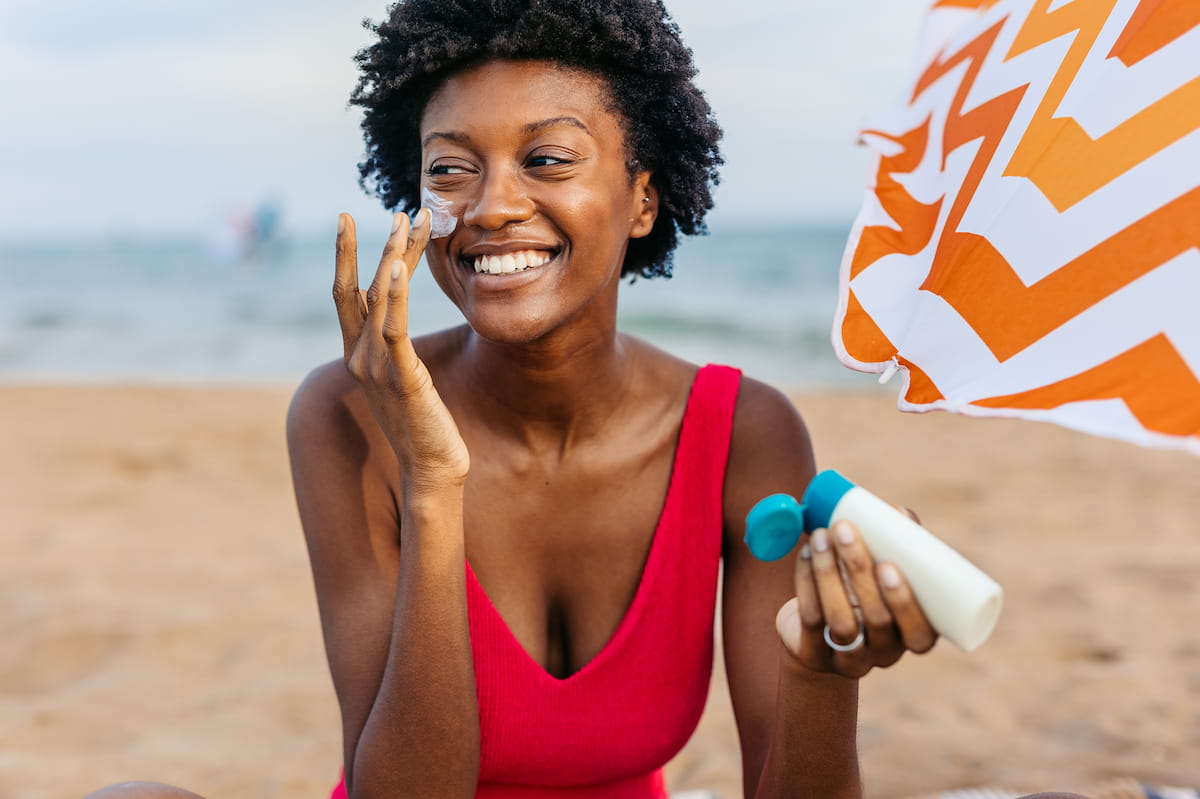
For generations, many Black people have heard that melanin provides all the protection needed from the sun. While melanin does offer some natural defense against UV radiation, it does not completely prevent sun damage.
While it’s true that darker skin contains more melanin, it isn’t immune to sun damage.
Yet in 2026, myths about sunscreen and Black skin continue to circulate—and the rise of online misinformation has only helped them persist.
Here are four of the biggest sunscreen myths—and the truths behind them.
RELATED: Exfoliating for Melanin-Rich Skin: The Best (and Worst) Methods
This is perhaps the most common misconception.
Dermatologists say this myth continues to keep many people from wearing sunscreen regularly, increasing the risk of skin cancer, premature aging, and stubborn discoloration.
While melanin provides some natural protection against ultraviolet (UV) rays, it doesn’t block all of the sun’s harmful effects. Black people can still develop sunburn, skin cancer, and long-term sun damage. In fact, skin cancers in people with darker skin are often diagnosed at later stages, making them more difficult to treat.
Although melanoma rates are lower among Black people compared with white people, the disease is often diagnosed at later stages in Black patients, which contributes to poorer outcomes. A major factor is that they’re diagnosed at much later stages.
According to the CDC, only about 55 percent of melanoma cases in Black patients are found early, compared to 78 percent in white patients. The five-year survival rate is about 66 percent for Black patients versus 90 percent for white patients.
RELATED: Top 4 Sunscreens for Black Skin
Clouds don’t stop UV rays.
According to the Environmental Protection Agency (EPA), 89% of UV rays can pass through scattered clouds, and 73 percent pass through broken clouds.
Overcast isn’t even foolproof—31 percent of rays still pass through.
Up to 80 percent of ultraviolet rays can pass through cloud cover, meaning your skin is still exposed even when the weather looks gloomy. UV exposure also occurs while driving, sitting near windows, or spending time outdoors during everyday activities like walking the dog or running errands.
“All skin types need protection, regardless of if it’s sunny or cloudy,” says dermatologist Dr. Nkem Ugonabo. “Not only is it important for preventing skin cancer, but it helps to prevent the worsening of hyperpigmentation, melasma, and sun spots. It can also prevent fine lines and wrinkles that are caused by the sun.”
That is why Dr. Ugonabo suggests wearing a broad-spectrum sunscreen with at least SPF 30 every day to help protect your skin from both visible and UV-related sun damage.
Darker skin has more melanin, which offers some built-in protection against UV rays, but it doesn’t mean you can’t get sunburned. Black people can and do experience sunburn after prolonged sun exposure, although it may present differently than it does on lighter skin.
Because redness may be harder to see on deeper skin tones, sunburn can sometimes be overlooked.
Instead of redness, sunburn on darker skin may appear as soreness, warmth, itching, peeling, or skin that feels tender to the touch. Sunburn or not—extended UV exposure can damage skin cells, increase the risk of skin cancer, and worsen hyperpigmentation and other forms of discoloration.
RELATED: 10 Natural Ways to Treat Dark Spots on Black Skin

Many people with deeper skin tones have avoided sunscreen because older formulas often left behind an ashy residue.
Fortunately, sunscreen technology has improved significantly.
Older mineral sunscreens often left behind a noticeable white or gray cast, which caused many people with deeper skin tones to avoid them. Newer formulas—including tinted sunscreens, gels, and lightweight chemical or hybrid sunscreens—are designed to blend more easily into a wider range of skin tones.
Dr. Ugonabo also recommends trying a tinted sunscreen, especially one containing iron oxides.
“Iron oxide offers extra benefits by preventing hyperpigmentation, as well as for people who want to avoid a cast,” she says.
Tinted formulas are designed to blend more naturally into a variety of skin tones while providing broad-spectrum protection.
Whether you’re concerned about white cast or prefer mineral, chemical, or hybrid formulas, there is a sunscreen option that can work for your skin and lifestyle. You may need to try a few products to find the right fit, but dermatologists agree that the best sunscreen is one you’ll actually use consistently.
Look for SPF 30 or higher. SPF stands for “sun protection factor,” which measures how well a sunscreen protects against UVB rays, a major cause of sunburn. SPF 30 blocks about 97 percent of UVB rays when applied correctly. Higher SPF products can offer slightly more protection, but no sunscreen blocks 100% of UV rays.
Reapply sunscreen at least every two hours, or more often if you’re swimming, sweating, or towel drying.
Choose a broad-spectrum formula. A broad-spectrum sunscreen protects against both UVA rays and UVB rays.
RELATED: 5 Sunscreens for Your Skin Type
Know the difference between mineral, chemical, and hybrid sunscreens:
Consider a tinted sunscreen. Many tinted formulas contain iron oxides, which provide visible light protection and may help reduce worsening of hyperpigmentation. They also tend to blend more naturally into a wider range of skin tones.
When applying sunscreen, it’s easy to focus on your face and arms while overlooking other areas that receive regular sun exposure.
Also, be sure to apply sunscreen to:
Protecting these often-missed areas can help reduce sun damage, support skin health, and prevent uneven pigmentation and premature signs of aging.
The best sunscreen is one you’ll use consistently. These examples include formulas designed to reduce white cast, blend into deeper skin tones, or provide additional coverage for concerns like hyperpigmentation.
For people concerned about hyperpigmentation, as Dr. Ugonabo mentioned, tinted sunscreens containing iron oxides may offer additional protection against visible light, which can worsen discoloration in some skin tones.
Chemical sunscreens
Hybrid sunscreen
Tinted moisturizer
SPF lip protection
Protecting your skin doesn’t mean changing who you are—it means caring for the skin you’re in. For Black communities, where skin cancer is less common but often caught later, knowing the signs and practicing prevention can make a meaningful difference.

By subscribing, you consent to receive emails from BlackDoctor.com. You may unsubscribe at any time. Privacy Policy & Terms of Service.