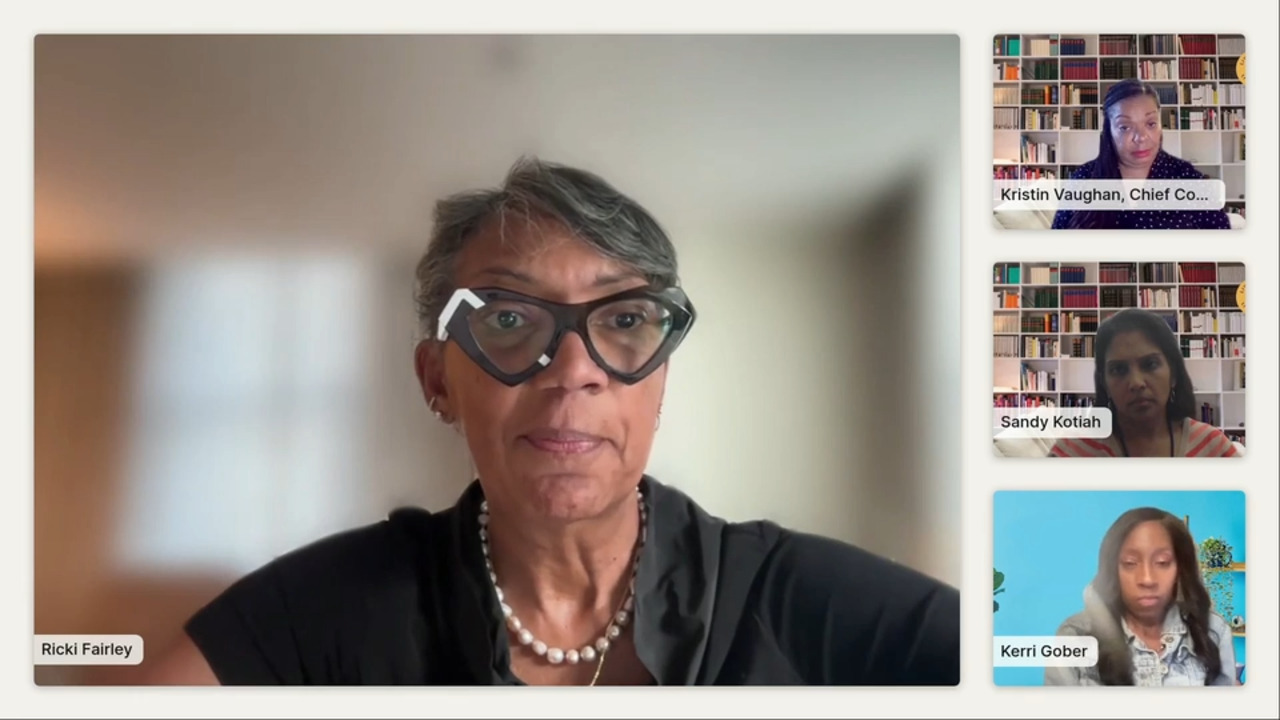
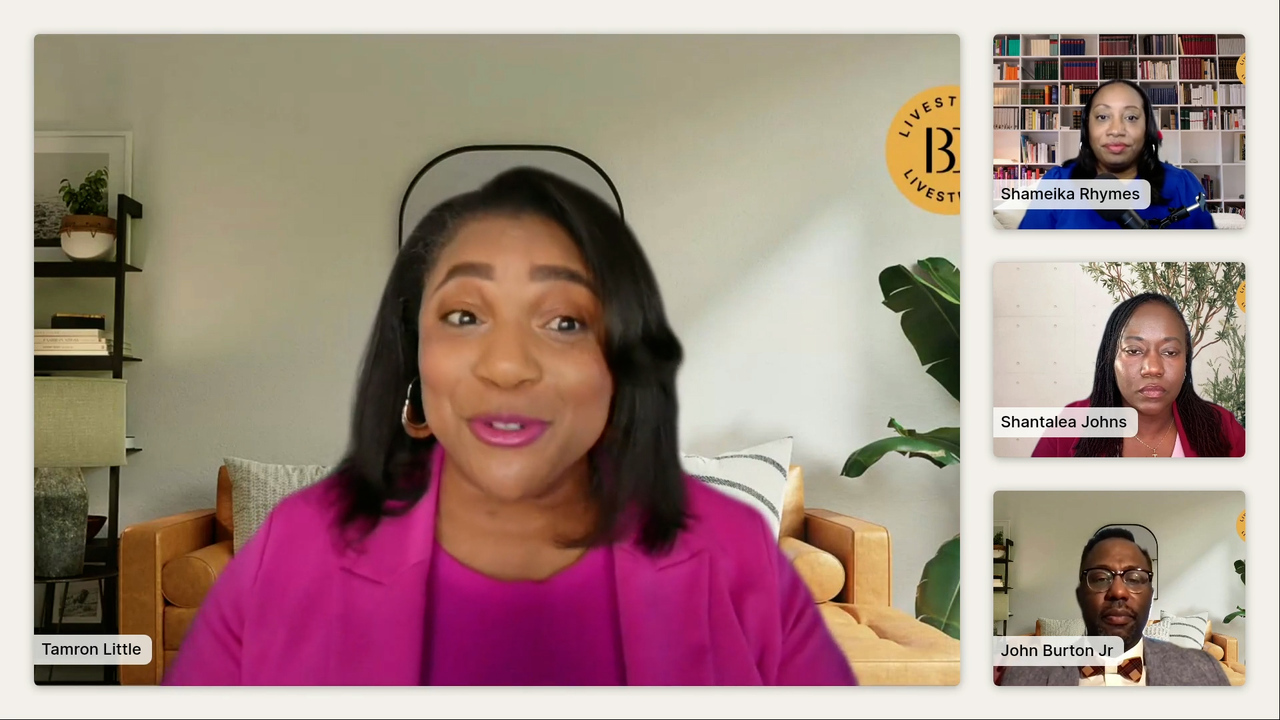
All right, welcome. Welcome, everybody. Thank you so much. We're here talking today with our special panelists. We're gonna start from the end. We've got well, we had the opportunity, the wonderful opportunity to talk to Mr. Matthew Knowles, of course. We wanna say thank you to him joining the panel with us today. All right. We also have Dr. Joy Jones, and Dr. Jones is the executive director of the Robert A. Winn Excellence in Clinical Trial Awards program from VCU Massey Comprehensive Cancer Center. Thank you so much, Dr. Jones, for st- for joining us today. We have another panelist here, another amazing person from Zero Prostate Cancer.
This is Mr. Brian Bragg, chief mission officer for Zero Prostate Cancer. And Dr. O. Kay Enya, the author of The John Henry Health Equity Playbook. And we're all excited to talk today about framing the next five years. So I just wanna thank all of my panelists. If we could give them a round of applause for joining us today. Snaps around. Yes. Yes. Snaps around for everyone. Snaps all the way around, absolutely. Absolutely. And so today is really a conversation. That's what we really want things to be. and that conversation, I think we I think that conversation is one that Mr.
Knowles really kicked, kicked off for us. One about gathering around the table and sharing our personal stories. When we're gathering, we're in the month of, of holidays. I know I can't believe that we're in November already. But when you think about the fact that it's Thanksgiving, Christmas, Hanukkah, all of the different holidays coming up, we gather around the food, and we're also gathering our family.
This year, maybe we start gathering and talking about our health, and not just football, sports, as you mentioned, Mr. Knowles. let's not just talk about those things. Let's talk about our actual health with our family. Mr. Knowles, I know you spoke about generational health being a part of your family's conversations. If you were talking to your daughters and their children, your grandchildren, three generations, and you were sitting around your dinner table, which what an amazing dinner table I would say that would have to be. I would love to be sitting around that dinner table with you as well.
What stories would you share that you might think would shift how they think about their health? Well, we, we talk a lot about the value of early detection. fortunately, I was, stage 1A when I was diag- diagnosed. I know my former wife just announced, her, challenge with breast cancer. She was also stage 1A. So we talk about the importance of getting tested early and, and how critical that is, and we also talk a lot about genetics, in our family, in our family history. Yeah. Now, that's amazing, and that's something, no matter who's around the dinner table, you really have to start thinking: What is the family history?
A lot of times, we know somebody passed away. We don't know what condition they maybe had, whether they were battling with something. We know, you know, Uncle So-and-So or Aunt So-and-So is no longer with us, but we don't always pass on what they were dealing with. And when we all go into the doctor's office, and they have you fill out the forms about your family history, sometimes we're leaving a lot blank that we should actually know.
Dr. Enya, you, One, congratulations on your second book. Thank you so much. I appreciate it. Yeah. Yes, excited. More snaps. Thank you, Brian. More snaps. Yes. Thank you. you know, you, you came up with The John Henry Health Equity Playbook, and in a world of generational health, in a world where we're talking about storytelling, what is it, as we head into the holiday season, what is a story that you think would make this next generation healthier? What are some of the tips you put in your book that start those conversations? Yeah, thank you so much for having me. I was very intentional about the way that I framed my book, using the John Henry legend, but actually, there are two real-life John Henrys, that shaped, this book.
and, one was actually in the, in the 1860s. He was a recently released convict from prison. he was a, a, a, a nineteen-year-old Black man who was tasked with working on a railroad. and then there's another John Henry Martin, who, in the 1800s as well, he was a North Carolina sharecropper that had the, interest in helping getting his family out of debt- ... but at the cost of his health. and so I think c- most of us know, writ large, what the John Henry legend is, and there's a plethora of ways in which, I use it as a metaphor for stress and strain and racism and systems, and the ways in which Black men, are seen and treated as you navigate systems.
And so part of my, approach is now to contemporize Black men and to help to reimagine how we show up, as, assets, as brilliant Black men that contribute to society.
And so, you know, kind of thinking about- what that means from a generational perspective, my dad and, and three of my uncles are prostate cancer survivors. And so this is very real for me. And I've, and I, and because of my background, and yes, I am taking care of myself, right, in terms of self-care and soul care, but I have challenged myself to have those hard conversations with my family, my, my dad, my uncles, and my, my brothers, to say: "Hey, have you gone to the doctor this year?" I actually got my PSA done about a month ago, and it's, point- it's zero point eight.
Normal, right? and I'm really, glad that, I can share that with my family to demystify and to normalize finding ways to discuss health and well-being. It is so important, even in terms of mental health. That's a whole nother conversation. Yes. Right? Yes. But just to kind of, to, to put a kind of a point on it, is to say that, having the language and the support is important. One of my mentors says all the time that, that you can't be your best self by yourself. It takes community, it takes a village, and that's why we're here. Wow, that is so true. The community aspect of it is so important.
Everything you just said there, and, and being able to tell people-- congratulations on the, on the number. But being able to tell people and share with people the number, and even to look at them: "Do you know your PSA number? Do you know your PSA number?" "Oh, no, I haven't gotten that." "Well, why are you not getting it done?" You know, so those are the kind of conversations that I think we have to normalize, especially as we're framing our health moving the, in the next four, the next five years.
That brings me to you, Brian, Mr. Bragg- Hey ... talking about Zero's Blitz The Barriers initiative. You're looking down the line as well, and you've got some major numbers that you guys are trying to meet. How are you going about getting people to start having those community conversations? How are you getting people to have conversations with one another? Is it in the barber shop? Is it in the schools? Is it around the family table? Tell us a little bit about your initiative with saving a hundred thousand lives by twenty thirty-five, and how can you-- what is the importance of reaching that goal, and how are you going to get there?
Ooh, how are we going to get there? That's an excellent question. We have plans, Kristen. So, Blitz The Barriers is the largest public health investment in prostate cancer ever. And so when you think about framing the next five years, we are pooling twenty million dollars into twelve communities that have had the highest, historically, disparity rates when it comes to screening for prostate cancer, initiation or engagement into treatment, and quality of life or mortality outcomes. So it's huge, and so w- we're, we're, we've sort of laid the base work, so transformation is absolutely the key.
Now, how it starts, I'll just A quick story. When I became chief mission officer, it was after fifteen years working in FQHC leadership positions in public health in Chicago. Having had numerous conversations about mental health, substance use, infectious disease, HIV, all the vulnerable topics when it comes to men in my, in my group.
Four of them, after I got this position, came out like whispering: "Oh, by the way, I have prostate cancer." Now, we've talked about marital issues for those that were married, family issues, raising children, financial cha- I mean, we've talked about all some nitty-gritty things that had set the table for vulnerability and trust. But that, for some reason, was an area that they could not get past the stigma and the fear of voicing it until I had this position. So with Blitz The Barriers, our key thing is a couple of points. One, raising awareness and, about their potential risk, providing education about that risk, and normalizing the conversation.
Those of us who've been in public health, we know about that from some of the other dis- you know, chronic conditions, about normalizing a conversation about hypertension or diabetes or HIV. It's no longer the talking about it doesn't give you anything. It just normalizes the conversation about, "Hey, have you had your test?" So the kind of work that you're doing. Then we're working with community partners, both traditional, like clinic-based or clinical partners, but other non-traditional partners to help elevate awareness opportunities. So where there is a health fair, can we add prostate cancer to that conversation?
if you're doing some screenings, how do we add volunteers to that event to help elevate and get greater impact on the screening event? So if you get to screen a hundred and fifty men, can we get to three fifty? Do we have that kind of capacity, and what will it take to get there?
So we saturate, m- you know, these communities with education, with screening events, with provider education, because some primary care spots are not, up to date with what the current guidelines are. I've had some conversations, and some of these primary docs or primary providers are, "Oh, I just do the DRE." I'm thinking, "Really? There's a blood test that makes it a lot less, um..." It's more patient-centered, you know, for those, the community members, and less, you know, problems and, and pushback in sort of having that conversation. So giving information to both patients, community members, those at risk, those who may not be patients, care partners and care providers, and then clinical providers to make sure that anyone at risk-- well, first of all, everyone knows their risk.
For those who are in elevated risk, have access to screenings. Those who get screened have access to resources to help them navigate along the patient journey. So the final piece of it is a patient navigation tool. And patient navigation is not new.... but it is sort of new to prostate cancer at the scale in which we plan to provide it. So that way, we are doing clinical-based practice navigation, community-based practice navigation, community health workers. Also, I'm part of the Community Health Caucus. That's not new, but working wa- walking alongside those who may have a diagnosis or their care partners to make sure at each step along the way, they get guideline concordant care.
So when we think about screening disparities, we can just, you know, lessen those.
When it comes to initiation of treatment, we can lessen those. And when it comes to quality of life and concordant care, we do- eliminate those disparities as well. Normalizing this conversation outside-- and, and it's helpful to have father to son, s- you know, uncle to, you know, to, to cousin and so forth, but when you have peer-to-peer, it elevates. So it's not just three families on the block that get connected, it's the entire block that gets transformed when it comes to prostate cancer education. And that's how we help support and elevate all the other collective work, to make sure that holistically, we, we have a, a more transformational work on generational health in all communities.
Not just communities at risk, but all communities moving forward. That's amazing, the work that you guys are doing, and the initiative that you've set out to do. I mean, I really think going the course that you guys are going, you really do have the ability to, to change the course and the narrative that's out there. I know stigma- Yeah ... is a big part about it. So when you talk about the, physicians that are saying, "I only do the digital, you know- Rectal exam ... exam," the digital rectal exam, that's where a lot of the conversation stops for a lot of men. As soon as they get to that, they're like: I'm not gonna get my prostate checked.
That's not what I wanna do. Too much of the hand still, you know what I mean? Too, too much hand. Too much hand. Right. Right. But when you point out things like, you can get a PSA screening, that's a blood test.
Yeah. That's the blood test. So knowing your PSA number, not necessarily doing the, the DRE right off the bat- Right ... but really starting with a blood test- Yeah ... could be transformative. Yeah. Just that alone, so- Yeah ... that's, that's an amazing thing, and I love how you said you're working that into community events- And- ... and discussions as well. And it'll take, you know, I'm glad that we're here to participate with blackdoctors.org and other colleagues, the Men's Health Caucus- Yeah ... Dr. Enya. I mean, it's gonna take everyone together to make- Absolutely ...
this whole thing work, and so we're, we're happy to be maybe initiators of the conversation at this scale. Yeah. But others have been out there doing some work, so we wanna get in, walk alongside, collaborate with, and elevate this conversation in a big way. I love that, and that's why I wanna bring in Dr. Joy right now. We're talking L- let's talk a little bit on the research side. I mean, you are the executive director at the Robert A. Winn, Robert A. Winn Excellence, Program, and you're in the Clinical Trial Awards program over there. The Robert A. Winn Excellence in Clinical Trials Awards program altogether.
you're advancing generational health by ensuring that every community can participate in some of the research that's out there, and benefit from the cutting-edge clinical research. Can you explain a little bit about how you're going to do that? Sure. Thank you. And I wanna just thank blackdoctor.org and American Public Health Association for the opportunity to be here, and for launching this really important initiative on generational health.
I'm gonna start with, you know, sort of why clinical research matters. The clinical trials are really sort of the foundation of evidence-based medicine, so it tells us what works, what's safe, and it's how people really gain access to the most innovative therapies. but we know, that too many clinical trials still don't reflect the diversity of the patients that we serve, and that's also reflected in the researchers or the investigators that conduct the research. And that has real consequences. when certain groups are missing in the data, then treatments are less effective or even harmful for them, and that serves to continue to erode, trust in a system that, for many communities, has already caused harm.
So the, the Robert A. Winn Excellence in Clinical Trials Award program is working to, to change that. Through our Career Development Award program, we are creating a new generation of physician-scientists who is committed to, you know, conducting research that is excellent and equitable, but, you know, that starts with listening, partnering, and building trust with communities. And that's what we see as, being important, to build trust with communities so that they become part of the research- Mm-hmm ... and they're more likely to, to engage in the research endeavor. So to date, we have trained more than three hundred and thirty physicians, um- That's fantastic.
That is fantastic. And we're- Yes, yes ... still going. And early data is showing that, that it's, it's working. So eighty-seven percent of trials that are led by our Winn Award scholars are more representative than industry standards.
Mm-hmm, mm-hmm. And two-thirds of trials are, enrolling more than twenty-five percent underrepresented patients in their trials. I'm really proud to say that, two-thirds of our scholars are women, and more than fifty percent are coming from communities underrepresented in medicine.... and so by investing in people, by, mentorship and collaboration, and making inclusion, the standard, then we're serving to not just, advance science, but to build generational health by developing, creating a workforce, that actually reflects the communities that we serve. That is amazing.
That's amazing, because when you're saying that the workforce reflects the community, when you're saying the people that are going to benefit from the clinical trials are gonna be recognized and being part of those groups, that's where you really start to really see a difference. building the workforce up, I think is something that we can all agree is something that's so important. Because we have seen declines in the workforce of people of color, diversity involved in, the workforce out there. So the fact that your initiative is really helping build that, and you're seeing numbers, and seeing that tide change, is really some valuable work that you're doing.
So that is great to hear. switching gears a little bit back to you, Mr. Knowles. we're, we're talking a lot about health history. We're talking about screenings, and now obviously about workforce development, seeing more people where equity is the strength, among what we're doing.
when we talk about, men, Black men being at the highest risk for prostate cancer, and how that silence can be deadly, I loved what you- how you reinforced that in your, in your keynote. How can storytelling help us change those patterns? I know we talked about around the family table, but how, to Brian's point, how do we get people to not just wait until afterwards and kind of whisper to one another, "You know, my PSA number is high," or that sort of thing? How do you make that something that's more common? Yeah, I- How does the storytelling become part of it? Yeah, thank you.
I, I think we learn. I, I think knowledge is power. I think a lot of this is we just don't understand the healthcare s- care system. Men don't understand that it is a simple blood test for a PSA. Yes. I think it's about engaging. You know, it's, it's, it's interesting that as men, we will make sure that we get a haircut every week or two. Yep. We will make sure that our car is washed- Yep ... every week or two. But we won't have that same energy- Like, yep. We won't have that same energy about our health. Yes. And, and I think we have to change that narrative, and we have to engage the community.
You know, when you-- when I hear Blitz The Barrier- Yeah ... when we talk about prostate cancer, what comes to mind is me as football. Yeah. What come to mind to me is that energy when we're about to bliss- blitz that defensive line, and everybody comes up to the line. Yeah. That's the community part of it. We need everybody at the line- Yeah ...
of defense, and we're going after this thing called prostate cancer. Yeah. And it's gonna take each and every one of you sitting in this audience to spread the word and engage and network. It's offense and defense, is what it sounds like. It's being, going after it, and also defending against it. that was a wonderful event, Blitz The Barriers. I had an opportunity to be a part of that, Black Doctor partnering with Zero, and, and as a media partner in that event. And that was amazing to have, Mr. Knowles up there, Montel Jordan talk, and, many other professional athletes that were retired.
That really seemed to open up the door of communication, too. It's something about letting people kind of get in those, those spaces, and feel like it's okay to share. One of the things you mentioned, Brian, was people having agency over their own health. Going in and advocating for themselves at the doctor, and really knowing if that doctor says to you, "You don't need the PSA screening. We'll just do the digital," to know to even go in and say, "Actually, no, I want this type of screening. I, I want you to be able to do that," or, you know, "If you look back at my file, my family history shows I should be getting that screening." What do you have to say about just, like, agency of people going in, really advocating and being advocates for themselves, for their health?
Whether it's even for prostate cancer or for anything. Yeah, for anything. And so I think, those who have been a part of APHA for a long I've been in, in A- involved since 2010, and that's a strong message about making sure that we provide education and empowerment for folks to be, you know, part of that other half of a shared decision-making conversation.
To, that way, you can meet a provider, your clinical provider, where they are, to make sure that you are em- engaged in that conversation, not just accepting or being passive about your health. it involves not just the individual or, you know, en- engaged in that conversation, but the care's- the support system and the care partners. We've mentioned that, you know, in your opening remarks, Dr. Knowles, and we've mentioned it in some of the friends that we've spoken about, and even with the, p- you know, primary investigators. It takes a lot of folks to help, you know, keep somebody propelled through the system to make sure that their outcomes are really healthy and strong.
But to your point, initially, it's just, does everyone know their risk? And so for a lot of- Yeah ... folks at risk, African American men, veterans, those who live in rural communities where access may be an issue, you may not be thinking about your prostate health.... or if you identify as someone other than male, you may think, "Well, maybe that doesn't cover me because of my orientation." If you have a prostate, you should know your risk for prostate cancer, and that's just a question. Asking the question doesn't give you prostate cancer. It doesn't make anybody ill.
It just makes sure that you are given the information that you need, and knowing how you get screened if you are at elevated risk, to know the difference between a PSA test up front, there may be some confirmatory tests when it comes to a DRE on the back end of it.
But really, you're giving blood anyway if you are fortunate to have a primary care provider. And like making sure my car stays clean, I get an annual checkup. So then you go in, they're drawing blood anyway. Then like, "Hey, just take some blood for my PSA test," and moving forward. Agency is everything, and so I don't want to put the responsibility solely on the person at risk, but it's a shared responsibility and an accountability for everybody to make sure that we're healthy. A lot of fraternal organizations with whom we partner, like I Am My Brother's Keeper, you know, is a key thing.
So if that is the case, then, you know, be your, you know-- love someone else enough to help them on this prostate cancer journey. I love that. I love that. Dr. Enya, you've got the John Henry, Health Equity Playbook. What other things should be- everybody should be talking about? What should, what-- when we talk about framing the next five years, what else should we be talking about as well, and how do people frame that narrative looking forward? So I'm going to wear two hats t- to answer that question. One is my scholar activist hat and my policymaker hat. there is a reason.
So I am a former House and Senate staffer on Capitol Hill and a former lobbyist. I understand how the policymaking process works. And the, and, and part of the impetus behind the book is to help people shape policy at the local, state, and federal levels. and so, in terms of next year, we have midterms next year. I wrote the book as, as a tiered approach, taking a four-year approach to provide a framework for funders, for partners, groups, to have context, language, and data to say, "Hey..." Actually, my book is the first of its kind to actually pull together a Black men-focused and grounded health policy agenda.
And I've traveled across the country, conferences, summits, conventions, podcasts, et cetera. So this is from lived experience and my research. And so, I say all the time that if you're not at the table, you're on the menu. And politics will impact you whether you want it to or not. So as we think about midterms next year, part of my goal and passion is to ensure that the voices of Black men are heard loud and clear on every policy and research agenda at the local, state, and federal levels. Why? Because Black men, on one hand, are invisible when it comes to their health and well-being on policy and research agendas, yet hypervisible when it comes to the criminal injustice system.
Right. That's just one data point. Now, I use the John Henry metaphor to help frame my book. So, so I lead with the, the John Henry story legend to help humanize who we are as Black men, a- and then I follow it up with data. So it's a mixed methods approach. The quantitative, the numbers, survey, et cetera, data, hard numbers, but then the qualitative, storytelling, narrative- ... to make it real, right? And as well as a policymaker, as someone who has been on both sides of the table on Capitol Hill as a s- as a, as a staffer and an advocate, it is leading with the story.
Leading with the story, that's what resonates. That's-- and I've actually helped train people, train activists, to tell their stories- ... because it makes a difference. And so this is a multifaceted approach. And again, as we think about midterms next year and then twenty twenty-eight, thinking about generational health- Yes ...
ensuring that all of the data that I have collected, all the work that we are doing, is on every policy and research agenda at the local, state, and federal levels. That is so important, and you're right. Absolutely. Absolutely. That inclusion, health policy, all of that being combined. the midterms coming up, absolutely making sure that Black men, Black women, all the different groups are being represented. But like you said, there's a disproportionate level how Black men are being included in other discussions. Let's include them in health policy. Let's include them in research.
Dr. Joy, when I think research, I think again about workforce development. I think about getting clinical trial investigators. I think about, how do we get more people into the healthcare space? And then how do we get those people included in the research, in the development? Because the way we start shifting that narrative that Dr. Ken- Dr. Enya is talking about is by making sure that, the, that we're involved in the clinical trials, that the clinical trials are involving, research into things that are involved with our communities. How do you look at building up the next five years in terms of building more clinical trial investigators, adding more doctors, adding more people in the healthcare profession?...
Thank you for that. So I was thinking about, you know, I think one of the earlier questions that we talked about was, you know, how, you know, when do you get students, when do you get kids involved in, in this process?
And what I was thinking was that, you know, there's not really a specific age to get, to start talking about, pathways for students about healthcare and research. But it's about sparking, it's about exposure and early on, and giving exposure and, and, and, inciting curiosity. And so, you know, we can start early. You can start when kids are little, when they're, inquisitive. You know, giving them exposure, letting them explore, ask questions, and understand that science really begins with curiosity. And then as they get older, it's, you know, they need to see it in practice.
And so to-- that's where opportunities like science clubs or, hospital visits or career days gives them more, you know, sort of sense that like, this is something, this is a pathway, this is something that I could do. but representation matters. And so for young people to be able to see a doctor or researcher that is, that looks like them or that comes from their community, it makes it more possible. It makes it seem more real. And so that's why, as part of the Robert A. Winn Excellence in Clinical Trials Award program, we created the Clinical Investigator Pathway program, which is for medical students.
And it's really designed to, provide exposure to medical students early on in their academic programs to what pathways in community-based clinical research can look like. Um- So they can actually start- So they can actually see- Seeing people who look like them, serving as clinical trial investigators, getting them more involved in becoming clinical trial investigators, and then those clinical trials reaching out into the community more, so the people are being seen more, the trials are being done within the community- Yeah ...
and really building a, a pathway to more workforce development and inclusion. Absolutely. Yes. That's fantastic. So like you said, the representation matters. I've talked to many people, I don't know, of people that are here, a lot of people have told me, "I didn't have any Black doctors when I was in school. I didn't take a course from somebody who looked like me when I was in medical school." That is a big, that is a big pill to swallow, that we're not out there enough for people to be able to see one another in those kind of areas, and then letting them know, this is the way that we can move forward.
I see somebody who looks like me doing that. You know, Mr. Knowles, when I saw, you know, your history, we always know about you as a music executive. We know about you in those forms. I did not know about your background in science and in research. Was representation something that got you involved into the sciences early on, or how did you get into that before your music career? I think I was always curious as a child and encouraged that by my parents to be curious. I enjoyed my twenty years in diagnostic imaging, and I, I think what we're hearing also, and Brian, you said something really im- important.
Often when we get a comprehensive blood workup- Mm-hmm ... a lot of men don't know that they can request and say, "Well, you're drawing three vials of blood. I'd like to get a PSA exam." a lot of people don't know that, and that's the benefit of what we're doing today, is spreading that type of knowledge and information.
Yeah. but I, I really enjoyed those twenty years, and it saved my life. Really? It actually saved my-- I used to sell xeroradiography in the eighties, the leading modality for breast cancer. And when I had those drops of blood in my chest area, I knew. And when I talked to my physician, he said, "Man, I've been doing this for forty years. Nobody's ever asked me for a mammogram." And I use that example, is that sometimes we have to be our own advocate. Absolutely. Men have to be their own advocate for prostate cancer. And, and ladies, we actually need your support. We need you to leverage.
We need you to make sure and ensure that the men in your lives take care of themselves. I know one thing, I can count to four. I know that stage I cancer treatment versus stage IV cancer treatment is remarkably different. Yes. That's why I have always been, regardless of the cancer, it's a, a, a medical condition. It's about early detection. The outcome is so much different. So different. Early detection really is the key. That's really what we really need to, to zone in on, early detection and everything. So Brian, how do you continue to push for the early detection? How do we really get people-- like you said, whether it's prostate cancer or something, an- another form of cancer or any conditions, how do we really get people out there to make the change?
Is it, is it the doctors? Is it doctors having more conversations with their patients? Is it family members? Where does the discussion start, and how do we move it forward?
'Cause a lot of times we find that people aren't listening always to their doctors or to one another. How do we get the conversation going? Who is it between? Well, it's, it's all the, the, the, the folks that you have mentioned at this table, right? And I-- so one way, you think about mass awareness. So our CEO, is a strong advocate from the breast cancer space and moved over into the prostate cancer space. And so everybody knows in October, it's Breast Cancer Awareness Month. Many sports teams and, and, you know, and non-sports organizations alike are familiar with the pink ribbons and so forth, and they go all out, and that normalizes the conversation around breast cancer.
I'm a son of a twenty-year breast cancer survivor, and so all the women in our family, that's a general conversation.... So prostate cancer, you know, in that space, not very many people know that September is Prostate Cancer Awareness Month. And so everybody gears up mid-September for October, but no one's spending any time mid-August gearing up for September, and, and the big blue. And so I think once you get awareness together, that helps, that helps move the whole conversation forward, whether you are a clinical provider, whether you are a community member who is interested about their risk, or whether you are a patient, you know, going, you know, wondering about the next step in your therapeutic journey.
So to the question about early detection, normalizing this conversation with lots of awareness and lots of education in the places and spaces where it can get traction.
You mentioned earlier barbershops. So, you know, sometimes the introduction, if it's in a clinical setting, it's like, you know, you go into the doctor- ... you might hear the blah, blah, blah, blah, blah, how much do I owe? And you want to get out of there. Yeah. But a barbershop setting might be a little different. Cards, playing cards might be a little different. At a football game or sporting event might be a little different. So how do you seed this in places where people may be a little less guarded, a little less concerned, if it's on the, a back, you know, a scoreboard, on a sideline, all the things that are happening in September that are kicking off, you know, then, hey, all right, what about prostate cancer?
That's kind of interesting. Anybody know about a prostate cancer? What's a PSA test? You know what I mean. have you had one? What was that like? If you can normalize it and get some curiosity- Yeah ... then it helps all the conversations moving forward. Well, you mentioned awareness month. November is, men's health also. Men's Health Awareness Month is in November, so hopefully, those kind of conversations will continue on as well. November is also n- also National Caregiver Family Awareness Month, and that is something that I think many of us, if we're in the sandwich generation, are really starting to feel that, the caregiver role, whether we're taking care of children, young adults, and then taking care of parents that are dealing with so many different health issues.
I believe pretty soon we're getting to the point where there's gonna be more people out of the workforce that are in retirement mode than we are people that are actually working in the workforce. at- and, and we've got more of the baby boomers, we've got more of the Gen X's that are all also about to be retiring. So as we've got this sandwich generation- That's kind of sad that the Gen X's are already retiring. Okay. I'm a senior Gen Xer. Man, we're that old already? Okay, maybe we're not retiring- Okay. ... just yet. I, I put myself in the Gen X category as well. but at the same time, she's like, "Oh, no." It's, it's there, y'all.
Gen X is there. We're- We're already there ... we're right around the corner. We really are. But when we look at it, and we talk about framing the next five years and our generational health, how do we talk about caregiving? How do we talk about managing and juggling that, the health narratives that we have with that, the changing face of going from your parents being vital people that are out there and, and moving around, to all of a sudden now, instantly you get the phone call. So and so, you know, Mom fell, Grandma fell, Dad fell, instant caregiver. any words or, or words of wisdom or support that you can offer, Dr.
Enya, about, stepping into these different roles? And over the next five years, I think not only are we gonna be the chief health officers in our family, talking about our generation of health, but we're gonna be wearing a lot of different hats as well.
Yeah. Yeah, so first, you know, I'll say that, you know, to be very clear, I am being very mindful of the messaging that I use when I'm talking about men's health. Because for me, it's about a call for solidarity. I'll say that white supremacy and structural racism create a scarcity mindset, where And it's a, and, and for me, health equity is not a zero-sum game. No. It is, it is about, it is about both and, not either or. It is both men's health, women's health, everyone's health. Yeah. Not either or. But the system, the way it's structured, intentionally would have you live in that space- Right ...
and believe that there are not enough resources, when actually there are. Yes. Now, like, again, I won't, this is a whole other conversation, you know, that I can have, but, but to your point a- about caregiving. I am blessed to still have my, both my parents alive and healthy. at the same time, my mother-in-law passed away in July. And so I've recently lived that with my wife, having to take care of her. She-- So the, the context was that five days after my son was born in the fall of 2023, my mother-in-law, stroke. Oh. She had a stroke, and we couldn't fly to Rhode Island, where my mother-in-law lives, until my wife was able to kind of heal up from the surgery, right, and just And so we were a- and so we had to wait about two months before we could fly to Rhode Island to see about my mother-in-law, who was, placed in a nursing home.
and so that, that kind of galvanized my own personal caretaker, caregiving experience, to see firsthand what this means.
Mm-hmm. and so over the course of the past few years, you know, while she had improved, and, you know, there's a lot of challenges with the healthcare system, which again, that's a whole other conversation. But to the earlier point about advocacy, self-advocacy and advocacy, being willing to speak up on behalf of your loved ones is such a vital skill.... and so to kind of frame caregiving, I think one way in which I, I think that can happen is framing it in the context of family community, like family. We are a community, and again, I, you know, I'll say, a- as, as a man of African descent, from a philosophical perspective, we, we are wired, I am wired, a- as someone who is communal, building relationship.
Other ethnic groups are different. but what I found, and I experienced this, this yesterday actually at a, on a panel, was, when we are trying to build a relationship, it's about being intentional about building the rapport, especially for Black and Brown people. Like, we have to feel comfortable, especially if we're navigating systems that weren't built with us in mind. We've got to be able to establish or have some sense of trust, but then challenge the systems to be trustworthy. Yeah. Right? So, I, I think it's about, to kind of frame it this way: structuring messaging campaigns in a consistent, sustainable way, long-term, to help shift the narrative around, around what caregiving means.
I think that's a very practical step- Mm-hmm. -and that takes some time, but it's necessary.
Excellent. So I'm hearing structure, messaging, narratives. I wanna thank you guys for joining us today on this panel. Thank you, Kristen. Thank you. And just wondering for one last thing, if you gave one word about generational health, what we need to do next. I heard screening from you, Mr. Knowles. Is that your, your one word of moving forward? I'm gonna do what I always do. I remember a prayer I read once- Okay ... I always, and every time I'm with folks. It was, "Pray not for a life free from trouble. Pray for triumph over trouble. For what you and I call adversity, God calls opportunity." That's what I wanna leave.
Think about those words. What you and I call adversity, God calls opportunity. That's what we're talking about today. I don't think we could end it any better than that. I just wanna say thank you all so much. As you gather around the tables this holiday season, gather talking about your health and your family, building the next generation of health, and health being wealth. All right, thank you all.